
The One Percent

British Museum
While the British Museum is quite the problematic and controversial institution, I still considered it an important spot to visit while I was in London. Besides, I’d taken a trip to Greece earlier in the year and still had some antiquities left on my list to see, so might as well, right?

Given that the Natural History Museum and the British Library were both part of the British Museum at their origin, it bears mention once again that the collections currently held by these institutions were originally amassed by Sir Hans Sloane, an Anglo-Irish physician and naturalist. Upon his death, he bequeathed the entirety of his collection to King George II, as he did not wish to see it dissolved. The British Museum was established that same year (1753).

When the British Museum first opened, it was the first institution to belong to neither church nor king, and to be freely open to the public, aiming to collect everything (and they meant everything). It was hosted in Montagu House, and opened to the public in 1759.


The Queen Elizabeth II Great Court was redeveloped in the late 1990s and reopened in 2000. The space has a tessellated glass roof engineered by Buro Happold and built by Waagner-Biro, and surrounds the British Museum Reading Room (the cylinder at the center), which was designed by Sydney Smirke. It is considered to be the largest covered court in Europe.


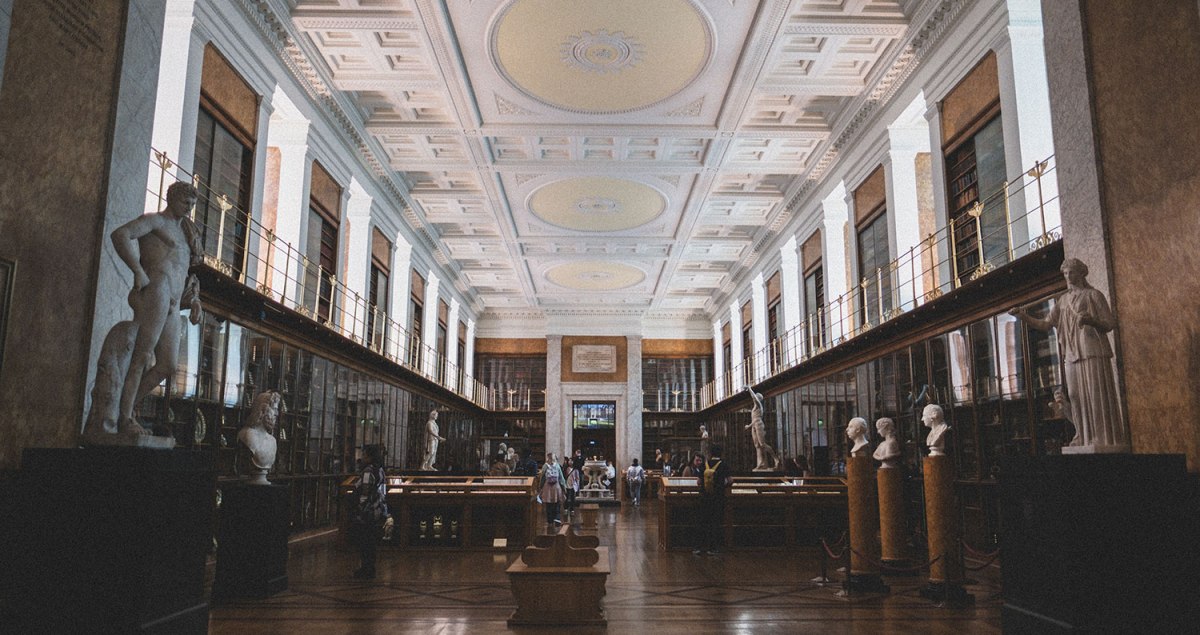
The Enlightenment Gallery formerly held the King’s Library, one of the most important book collections of the Age of Enlightenment, donated by King George III. It consisted of 65,000 volumes, 19,000 pamphlets, as well as countless maps and charts. Today, the book collection belongs to the British Library, and this room houses objects seeking to describe how the British saw the world during the Age of Enlightenment.


The collection of American Art currently held by the British Museum covers mostly the 19th and 20th centuries, and contains objects from the Paracas, Moche, Inca, Maya, Aztec, and Taino peoples. There are also artefacts representing the Inuit, Cherokee, and Arapaho peoples, among others.


Over the years after its founding, the British Museum received further gifts, including the Thomason Collection of Civil War Tracts and David Garrick’s (actor, playwright, theater manager) library of 1,000 plays, as well as Sir William Hamilton’s collection of Greek vases. Loot brought from all over the world by intrepid travelers, such as James Cook, further swelled the collection, until Montagu House was no longer able to hold it.


A kente cloth is a narrow-strip woven silk cloth which is traditionally created as a receptacle of cultural memory. This piece, created by El Anatsui, seeks to emulate this tradition while using symbolism (bottle-neck wrappers) to represent the erosion of cultural values through unchecked consumerism.


The British Museum’s collection of antiquities began with Hamilton’s donation, and was followed by the spoils gathered by the British presence in Egypt, Italy, and Greece in the 19th century. This resulted in such decorated objects as the Rosetta Stone and the Acropolis Marbles joining the collection. The museum also currently holds many examples of Assyrian and Babylonian antiquities.

The museum currently houses the world’s largest and most comprehensive collection of Egyptian artefacts (after the Egyptian Museum in Cairo), covering various Nile Valley cultures from the Predynastic Neolithic period up to the present day.


After the first collection of Egyptian antiquities, which included the Rosetta Stone (pivotal in the translation work of ancient Egyptian hieroglyphs), made it into the museum, the UK appointed Henry Salt as consul in Egypt. He worked with Giovanni Belzoni (explorer and pioneer archaeologist) after he was charged with amassing a large collection of antiquities to be brought back to Britain. Most of these items were appropriated and exported to both the UK and France, and are currently held at the British Museum and the Musée du Louvre.


Egypt eventually put in place policies to limit the export of objects found during excavations in its soil in the 20th century, but much of the damage had already been done. The British Museum has seven permanent galleries dedicated to Egyptian artefacts, and this is only enough space for them to be able to display 4% of the total Egyptian collection currently held by the institution, which is wild.


The British Museum currently holds the world’s largest collection of Mesopotamian antiquities outside of Iraq, numbering in over 300,000 pieces. The collection includes works from Assyria, Babylon, and Sumer, as well as entire rooms of paneled alabaster palace reliefs from Nimrud, Nineveh, and Khorsabad. Further objects come from Persia, the Arabian Peninsula, Anatolia, the Caucasus, parts of Central Asia, and Syria. A number of excavations took place in the 19th century, and as a result, I saw more Lamassu in the British Museum than I’d ever seen in my life (and I’ve seen my fair share of Lamassu).


These panels once stood in the Northwest Palace of King Ashurnasirpal II, who ruled Nimrud (present-day Iraq) in the 9th century BCE. These panels adorned the throne room and other royal apartments, and depict the king and his subjects participating in various activities, such as military campaigns, ritual scenes, and hunting.


The Greek collection at the British Museum is likely one of the most loudly controversial in the world, as Greece is extremely vocal about how they feel about having some of their most famous treasures off their soil.


The Nereid Monument is a sculptured tomb from Xanthos, in Lycia (modern-day Turkey), thought to have been built for Arbinas. It is believed to have stood until Byzantine times, when it fell into ruin and there remained until Charles Fellows found it in the early 1840s and had it shipped to the British Museum.


The objects, numbering in over 100,000, date from the beginning of the Greek Bronze age to the establishment of Christianity, and originate from the mainland and the Aegean Islands, the neighboring lands of Asia Minor and Egypt, and the western lands of Magna Graecia, which include Sicily and southern Italy. There are Cycladic, Minoan, and Mycenaean artefacts, sculptures from the Parthenon, the Mausoleum at Halicarnassus, and the Temple of Artemis at Ephesos.


Perhaps the most famous of these antiquities are the Acropolis Marbles, which were taken from the Acropolis by Thomas Bruce, 7th Earl of Elgin, during the Ottoman occupation. This included sculptures from the Parthenon, the Erechtheion, the Temple of Athena Nike, and the Propylaia. These sculptures (about half of the surviving works on the Acropolis) were then sold to the British government, and eventually made it into the collection of the British Museum. The remaining sculptures are currently held at the Acropolis Museum in Athens.


By the middle of the 15th century, all marble seating had been removed from the Panathenaic Stadium, including this specimen. It was given by the Archbishop of Athens to William Hamilton Nisbet, an officer of the British Army, and it was lost when the ship that transported it back to England sank. It was salvaged two years later, and eventually made it to the British Museum collection.


The department of Asia at the British Museum currently holds over 75,000 objects, covering the whole Asian continent from the Neolithic up to the present day. Many of these objects were “collected” by colonial officers and explorers in former parts of the British Empire, especially the Indian subcontinent.


The 19th century saw the demolition of Montagu House (1842). The current building was begun in 1823 under the supervision of Sir Robert Smirke, and, though not officially opened to the public until 1857, special openings were arranged to showcase the collections during The Great Exhibition of 1851. At the end of the 19th century, the building was further enlarged after the trustees purchased the 69 houses that originally surrounded it.


Today, the collection of the museum holds over 13 million objects, even after its original holdings were split off into the Natural History Museum and the British Library. Less than 1% of this collection is on display.


 Gold Colored Fox