

The Ancient Citadel

I have to say, when it comes to views to wake up and have breakfast to, it could definitely get a lot worse than this. Our hotel was a mere 15-minute walk away from the top of the Acropolis, and wishing to take advantage of the proximity to enjoy it without a huge crowd, our second day in the Greek capital saw us rise bright and early, stock up on coffee and Greek yogurt while delighting on this stunning view, and make our way over.


The walk, as you can see, involved some stairs and, yes, inclines. While there was definitely some huffin’ and puffin’ from my end (I am nothing if not consistent), I have to say, it was not so bad. It also helped that we went so early, as the temperature was lower, so at least I didn’t turn into a sweaty mess right away. Oh no. That came later.


Ακρόπολη Αθηνών / Acropolis of Athens
Known during ancient times as Cecropia, the Acropolis is an ancient citadel made up of the ruins of several ancient buildings:
- Beulé Gate
- Προπύλαια / Propylaia
- Ναός Αθηνάς Νίκης / Temple of Athena Nike
- Ερέχθειο / Erechtheion
- Παρθενώνας / Parthenon
- Θέατρο του Διονύσου / Theater of Dionysus
- Ωδείο Ηρώδου του Αττικού / Odeon of Herodes Atticus
While the Acropolis is believed to have been inhabited as early as the fourth millennium BCE, the architectural group visible today is the work of Pericles (Greek politician and general), who in the fifth century BCE coordinated the construction of those buildings that still survive today.

An ancient megaron, Mycenaean in origin, once stood atop this hill, though very little of it survives. It was surrounded by a Cyclopean wall, which served as its main defense up until the fifth century. “Cyclopean” refers to a type of masonry that uses enormous blocks of stone, so enormous that it was believed that only the mythical Cyclopes would have had the strength to use them for building.

After winning the battle of Eurymedon in 469, Kimon and Themistocles, Athenian politicians, ordered the reconstruction of the southern and northern walls of the Acropolis. Pericles then had the major temples, including the Parthenon, rebuilt by Phidias, sculptor, and Ictinus and Kallicrates, architects, in a time period known as the Golden Age of Athens. During the Roman occupation, a Temple of Rome and Augustus would be the last significant ancient construction completed on the hill.


Beulé Gate
The Beulé Gate was constructed during the Roman occupation of Athens. It leads into the Propylaia, and was constructed almost entirely out of the spoils taken from the Choragic Monument of Nikias.


You may be wondering about the peculiar, non-Greek name of this gate, and that’s because it’s named after its discoverer, Charles Ernest Beulé, a French archaeologist and politician.


Προπύλαια / Propylaia
The Propylaia served as a ceremonial gateway into the Acropolis of Athens and was built as part of the plan created by Pericles. Its architect was Mnesikles, and this is his only known work. His original plan had comprised a much larger building than was finally completed, with five halls, and which would have spanned the whole width of the hill.

Only the central hall, the north-east hall, and a smaller version of the south-east hall, reached completion. There are theories as to this deviation from the original plan, and they include objections to cost, to the move of other temples and shrines to make space, and practical considerations of the site as construction advanced.

Some slight changes were made during the classical period, including a central incline which was added to allow sacrificial animals to climb the hill more easily. During the Byzantine period, part of this building was turned into a chapel, and its central section was turned into a church in the tenth century CE.

During the Crusades, Athens was turned into a Duchy, and the complex was converted into a fortified Ducal Palace. During the period of Ottoman rule (known in Greek as Τουρκοκρατία, or “Tourkokratia”), the building was used to store gunpowder and artillery, and suffered much damage as a result. Any post-classical additions to the building were removed by 1875.


Ναός Αθηνάς Νίκης / Temple of Athena Nike
While in Ancient Greece Nike was the personification of Victory, “Athena Nike” is considered to be a variation of Athena as goddess of victory, or Athena Victorious.


In classical architecture, there are three canonic orders: Ionic, Doric, and Corinthian. They are differentiated by the width of their columns and the style of their capitals (the bit at the top of the column). The Temple of Athena Nike is the earliest full example of the Ionic order on the Acropolis.

The site was once occupied by a Sanctuary of Athena Nike which was demolished by the Persians in the fifth century BCE. A new temple was constructed over the ruins between 449-420 BCE during the Peace of Nicias, which ended the first half of the Peloponnesian War between Athens and Sparta. The temple went out of use during the persecution of pagans in the late Roman Empire, and in 1686, it was demolished by the Ottomans for building materials. It was eventually reconstructed after the Greek Independence in 1834.


In 1998, the temple was carefully taken apart so that conservationists could replace the floor, and its frieze was placed in the Acropolis Museum (though only partially, as some of it is currently exhibited in the British Museum). In 2010, a final restoration was completed, with much of the main structure, including its columns, intact, and a copy of the friezes set in place.


Ερέχθειο / Erechtheion
The Erechtheion was constructed to house the statue of Athena Polias. Its identity has been determined thanks to writings by Pausanias, an ancient Greek traveler and geographer, though this identification has become a point of contention in recent times.
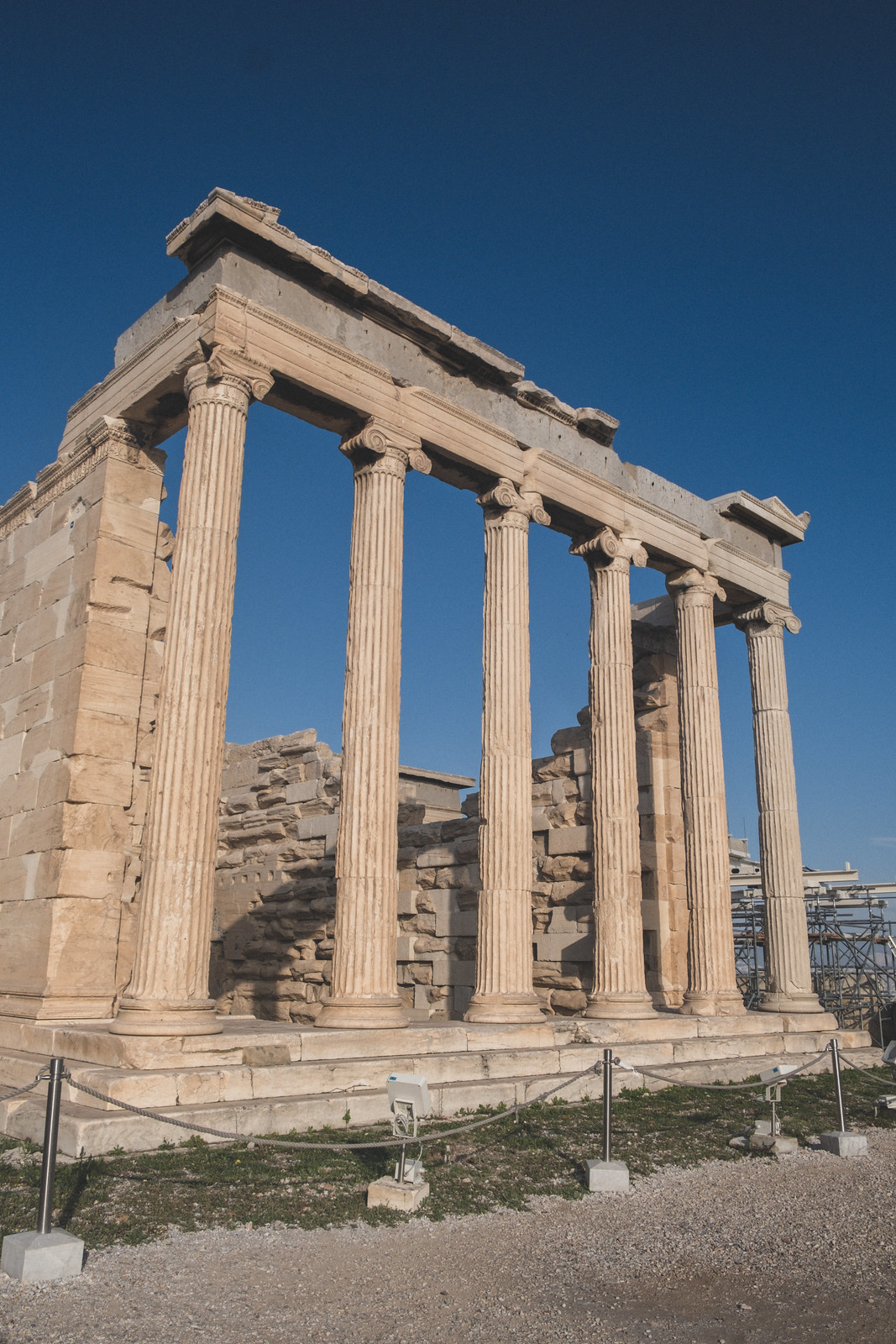
The precise date of its building is unknown, and the current temple is not the first of its kind, as it is believed that a Bronze Age Mycenaean palace was once on this spot. The current building seems to have been built in either 421-406 BCE, or in the 430s BCE, as part of the work carried out under Pericles.

Something that may strike you as odd if you know a bit about classical architecture is the building’s asymmetry — the ancient Greeks were lovers of perfect proportion and harmony, which makes the Erechtheion unique, though some believe that the irregularity of the site, or the evolution of the cults that used the building for worship, are to blame. Understanding this building has been further complicated by its reuse, damage, and spoiling in the post-classical period.

In the fourth century CE, it was turned into a pillared hall, and in the late sixth or seventh, into a three-aisled basilica, which was renovated in the twelfth century. During the Frankish occupation, the Erechtheion was turned into a Bishop’s residence, and in the Ottoman period, it became the home of the Dizdar’s harem, though this claim is contested. What we do know is that antique collectors were noted to come visit the building and take spoils with them.


The Porch of the Maidens originally held six sculpted female figures who serve as support (this type of sculpture is called a Karyatid). What you see here are copies of the originals, which are held in the Acropolis Museum — all save two: one which was destroyed by cannon fire, and another which is held at the British Museum.


Παρθενώνας / Parthenon
The most famous building in Athens, and certainly in the Acropolis, is the Parthenon. Dedicated to the goddess Athena in the fifth century BCE, its decorative sculptures, many of which were pillaged and are now held outside of Greece, are world-famous, and the building itself is considered to be a symbol of Ancient Greece and Western civilization. The temple was commissioned after the Hellenic (i.e. Greek) victory over the Persian Empire during the Greco-Persian Wars, when the Delian League, comprised of a number of Greek city-states led by Athens, was at its peak. The building also served as treasury to the city of Athens.

In the sixth century CE, the Parthenon was converted into a church dedicated to the Virgin Mary, and after the Ottoman conquest, into a mosque. During the Morean War, a Venetian bomb landed in the Parthenon, and as the building had been used to store munitions by the Ottomans, this caused a spectacular explosion, which severely damaged the Parthenon. It was in the early nineteenth century that Thomas Bruce, 7th Earl of Elgin, pillaged the sculptures from the frieze and pediment, which eventually made their way to the British Museum.


The word “Parthenon” comes from the Greek word parthénos which means “maiden, girl, unmarried woman.” As such, the Parthenon is believed to mean “the temple of the virgin goddess.” There is also a belief that “Parthenon” is a modern name that was never used by its contemporaries, who knew it as the Hekatompedos or Hekatompedon, with Plutarch having referred to the building as the Hekatompedos Parthenon in the first century CE.

Phidias, a Greek sculptor, painter, and architect, was responsible for both the architectural and sculptural plans of the Parthenon alongside Ictinos and Kallikrates.


The Parthenon is a Doric building, with 46 outer columns and 23 inner columns. The temple even plays with visual illusions, incorporating methods such as entasis (the swelling in the center of columns to make them look straight from a distance, as otherwise they would have looked cinched at the middle). The columns also lean slightly into the building, which would have made them seem taller and the building therefore grander.

The sculptures from this building are in the Acropolis Museum, the British Museum in London, the Louvre in Paris, the National Museum of Denmark in Copenhagen, and other museums in Rome, Vienna, and Palermo. Some pieces, once held by the Vatican and a museum in Sicily, have been returned to Greece. Many of those seen on the Parthenon today are copies.


Another absolutely great reason to go up to the Acropolis is… these views.


This is the Aeropagus, a rock that takes its name from Areios Pagos, or “Hill of Ares.” Supposedly, Ares was tried on this rock by the other gods after murdering Halirrhothius, the son of Poseidon. It is also allegedly the site of Paul’s sermon to the Athenians as told in the Bible.


Θέατρο του Διονύσου / Theater of Dionysus
Originally built in the fourth-fifth century BCE, this theater once had a capacity of up to 25,000 people, and it was in use up until the Roman period. It fell into disuse in the Byzantine period, and was neglected and essentially lost until the nineteenth century, when it was excavated and restored. Historians are able to piece together how elaborate this theater once was thanks to the plays that were performed here — for example, Oresteia (a trilogy of plays written by Aeschylus concerning the murder of Agamemnon by his wife Clytemnestra and her subsequent murder by their son Orestes), makes references to entrances and exits from a palace door, as well as to a roof from which a watchman looks out, a step to the palace, and an altar.


Ωδείο Ηρώδου του Αττικού / Odeon of Herodes Atticus
An odeon or odeum is a space created for singing, musical shows, and poetry competitions, and was a smaller version of a Greek or Roman theater. The Herodion, as it is also known, was built in 161 CE by Herodes Atticus, an Athenian rhetorician and Roman Senator, in memory of his Roman wife, Appia Annia Regilla (don’t “aww” just yet, as he may have been responsible for her murder).


Apparently, Regilla died by the hand of a slave belonging to her husband, who allegedly acted under Herodes Atticus’s orders. Herodes Atticus was eventually exonerated by the Emperor Marcus Aurelius (a former student of his), and he subsequently constructed several monuments in her honor.


The odeon had an original capacity of 5,000 people, and it remained intact until 267 CE, when it was destroyed by the Heruli. It was renovated in 1950, and has been used by modern performers, including Florence and the Machine and Yann Tiersen.


