
The Minster of the West

The name “Westminster” comes from the Old English Westmynstre, which itself comes from the abbey church: West (as it sat West of the City of London, the area known as Londinium in antiquity) + “minster” (which is an honorific given to certain churches). This settlement, separate from the urban area of London, was itself an important center of royal authority during Saxon times, and it was declared a city in 1540.


The City of Westminster was gradually absorbed into the urban area of London, though still not treated as part of the City of London, which was still defined by its Medieval walls. Eventually, it was granted status as a borough within the area of Greater London (is your head spinning yet?), covering Westminster, Paddington, and St Marylebone.


Today, the City of Westminster is home to many major landmarks, including Westminster Cathedral and Abbey, Buckingham Palace, the Palace of Westminster, Trafalgar Square, the National and National Portrait Galleries, and the West End cultural center. It is also home to a number of parks, including St James’ Park, Kensington Gardens, and Hyde Park.


The area marks its legendary origins in the 7th century, when a local fisherman named Edric ferried a stranger over the Thames to Thorney Island. This stranger, deceitfully dressed in tattered clothes, was actually Saint Peter in disguise, traveling to consecrate the area’s new church (which later developed into Westminster Abbey).


Historically, it seems the site began as a challenging place in which monks decided to settle for religious reasons (similar to Meteora in Greece). As Westminster Abbey became the official coronation site for English monarchs, the area grew in prestige and population, with the Crown making nearby palaces (first the Palace of Whitehall, then St. James’s Palace, and lastly Buckingham Palace) its official residence.


Westminster Cathedral
Formally called the Metropolitan Cathedral of the Most Precious Blood, Westminster Cathedral is the largest Roman Catholic church in England and Wales, and the 50th in the world.


It was completed relatively recently — in 1903, which seems like a while ago, but consider that this is also the year that Atlético de Madrid was founded, for some perspective. Designed by John Francis Bentley in a neo-Byzantine style, it is almost entirely of brick, without any steel reinforcements.


The building is significant because it wasn’t until the late 19th century that the Roman Catholic Church hierarchy had been restored in England, and so building at such grand scale had not previously been possible. Two attempts at construction were made — first in 1867 and later in 1892 — but it wasn’t until 1895 that the existing building truly began being built.


In keeping with the Byzantine tradition that inspired the building itself, its interior is decorated with decadent mosaics made out of pieces of marble, lapis lazuli, pearl, and gold. These decorations have been added over the years since the church’s consecration, up to the present time, with plans into the future for further mosaics to be added to its walls.


(If you’ve been reading this blog for a while, you’ll know I’m obsessed with Byzantine art. Want to see more? I got you: see the Byzantine and Christian Museum in Athens, the mosaics at Ravenna, the monasteries at Meteora, the Byzantine collection at the Metropolitan Museum of Art, and the Basilica di San Marco in Venice.)


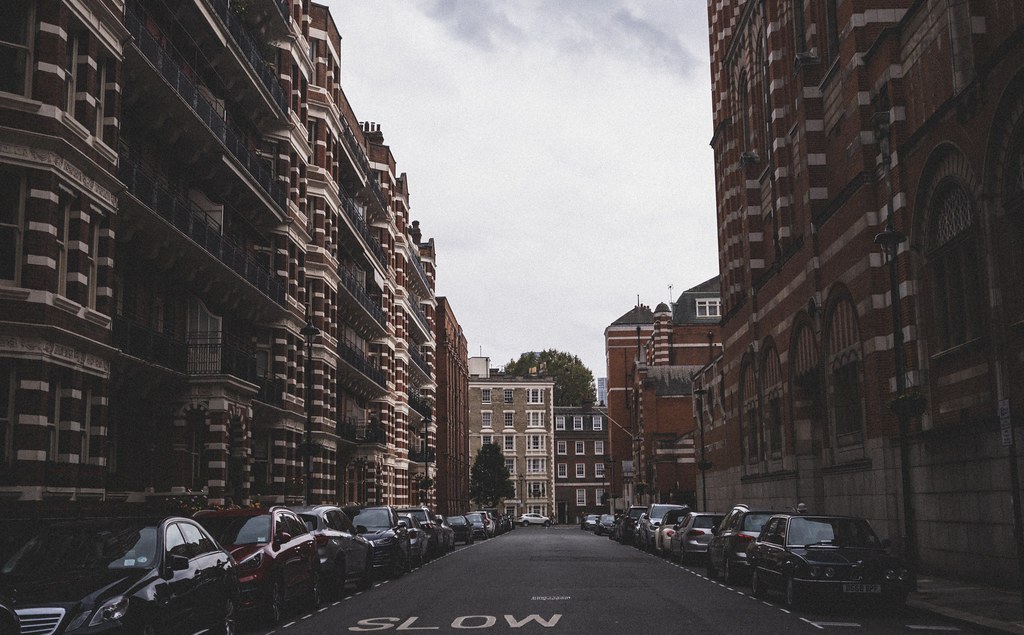
You may recognize Cowley Street as a shooting location for Mary Poppins Returns (for the moment when Jack spots Jane Banks in the streets of London and offers to give her a lift on his bike).


One thing that I loved about London were these blue plaques – they mark the site or the home of a historical personage or organization, and can be found all over. This one in particular calls out this house as being the residence of T.E. Lawrence, a British Army officer, archaeologist, diplomat, and writer who was involved in the Arab Revolt and Sinai and Palestine campaign against the Ottoman Empire during WWI. A 1962 film based on his experiences granted him the nickname he’s best known by: Lawrence of Arabia.


The blue plaque on this building marks it as the site of the National Union of Women’s Suffrage Societies’ office from 1910 to 1918.

 Gold Colored Fox
What a soothing, poetic series! We were just in London this summer (articles coming soon!), but this made me want to go back immediately and explore Westminster Cathedral!
All the best,
Stephanie and Jerome, Strafari
LikeLike
You’re so kind, thank you so much! ❤ I can’t wait to see London through your eyes as well!
LikeLiked by 1 person