
The Legacy of the Palaiologans

Παλαιά Ανάκτορα / Old Royal Palace
Completed in 1843 by the Bavarian architect Friedrich von Gärtner for King Otto of Greece, this building originally served as the first royal palace of modern Greece. A fire caused much damage in 1909, causing the royal family to move to the Crown Prince’s Palace, which is now known as the “New Palace” and serves as the home of the President of the Hellenic Republic. Ever since 1934, it is the home of the Hellenic Parliament, after it moved out of what is now called the Old Parliament House (and is home to the National Historical Museum).

Βυζαντινό και Χριστιανικό Μουσείο / Byzantine and Christian Museum
The building currently occupied by the Byzantine and Christian Museum in Athens was originally a private home known as “Villa Ilissia.” It was designed by Stamatios Kleantis, a Greek architect who also participated in creating a modern plan for the city of Athens, and resembles a Florentine palace.


The home was commissioned by Sophie de Marbois-Lebrun, Duchess of Plaisance, a French aristocrat who was a great supporter of Greek Independence. The villa was completed in 1848, and the duchess lived there until her death in 1854. Eventually, the building came into the possession of the Greek State, and for the following three years housed the Officer Cadets Academy. In 1928, it was granted to the Byzantine and Christian Museum, and it underwent extensive renovations right before the Olympics of 2004.


I was pleasantly surprised to find this replica of a mosaic from Basilica di San Vitale in Ravenna, lent to this museum by the Met.


The Byzantine and Christian Museum was originally established in 1914 in order to preserve the Byzantine and post-Byzantine cultural heritage present in the territory of Greece. Its collection is comprised of over 25,000 objects, including scriptures, frescoes, and manuscripts ranging from the third century CE to the Late Middle Ages. It is one of the most important museums of Byzantine Art in the world.


The museum’s collection takes visitors through the transition from the Ancient world to the Byzantine, detailing the evolution of society in various spheres as Christianity gained ground and the first examples of Christian art appeared. This was particularly driven by the Edict of Milan, when it was decreed by Constantine the Great in 313 that the Roman Empire would be tolerant of the Christian religion.


The Byzantine Empire is believed to have started with the move of the capital of the Roman Empire from Rome to Constantinople in 330. At its height, the empire spanned three continents around the Mediterranean — Europe, Asia, and Africa — though as German tribes attacked its western cities, it shrunk further into its eastern reaches. In 1204, it became nearly non-existent after the sacking of Constantinople by the Fourth Crusade (in which Venice was heavily involved).


The Christian church was at the center of Byzantine society, and most art revolved around the creation of icons and the decoration of ecclesiastical buildings.


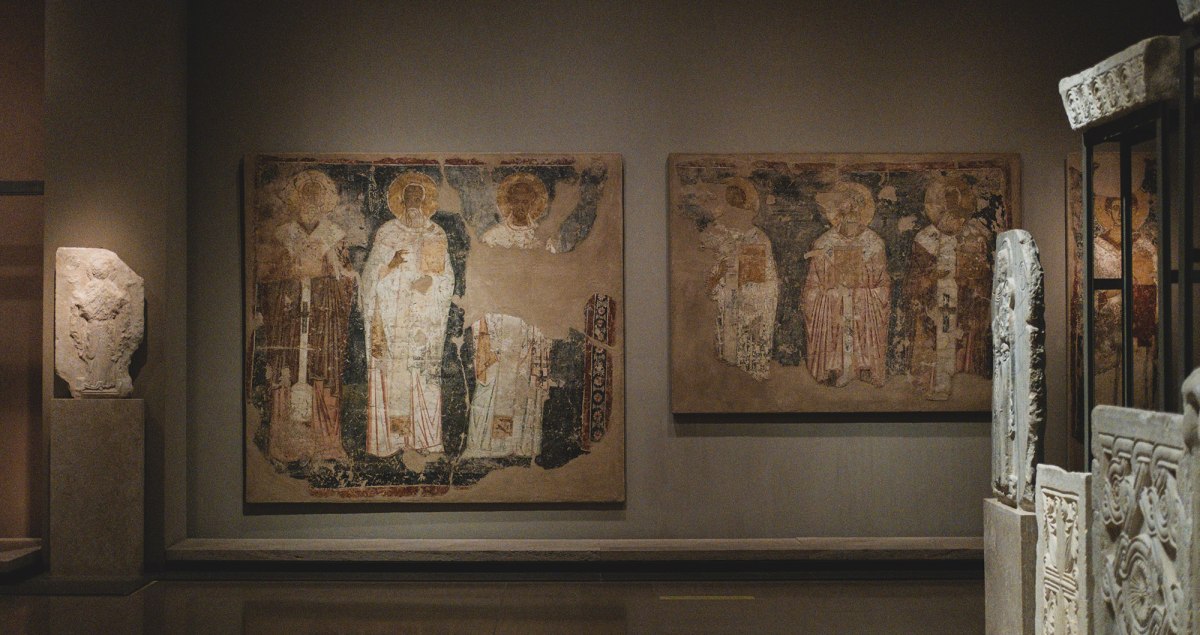
In the 1960s, the construction of a hydroelectric dam on the Achelous River, and the subsequent creation of the artificial Lake Kremasta, doomed a church to be flooded and lost. Its murals have been preserved and are exhibited as part of the museum’s collection.


An iconostasis (εἰκονοστάσιον) is a wall covered with icons and religious paintings which separates the nave from the sanctuary in a church, and it is a staple of Eastern Orthodox religious architecture.


After the sacking of Constantinople during the Fourth Crusade, Frankish and Latin principalities were created in areas of the Byzantine Empire. This allowed an unprecedented meeting of artistic traditions from the East and West to occur, creating a style that came to be known as Franco-Byzantine.


Constantinople was liberated from Latin occupation by Michael VIII in 1261, starting the most long-lived of all Byzantine dynasties, the Palaiologan Dynasty. It clung to power until 1453, with the fall of Constantinople to the Ottomans.


 Gold Colored Fox