
The Aegean giveth, and the Aegean taketh away

Εθνικό Αρχαιολογικό Μουσείο / National Archeological Museum
I think this museum was probably one of the things I was most excited to see (behind, perhaps, Meteora and the Acropolis, just a bit). It is filled to the brim with archaeological treasures from all places in Greece, covering a time span of thousands of years from prehistory to late antiquity, and contains the largest collection of Greek Antiquity artifacts in the world.


The first-ever national archaeological museum in Greece was established in 1829 in Aigina, an island off the coast of Athens, by Ioannis Kapodistrias, who was at the time Governor of Greece. After this, the collection was housed in many different places until an international architectural competition was announced in 1858 to build it a new home. Building began at the current location in 1866, and was completed in 1866. It was funded by the Greek Government, the Greek Archaeological Society, and the Society of Mycenae, and Eleni Tositsa donated the land upon which it sits.


Initially, it was known as The Central Museum, and was renamed in 1881 by Prime Minister of Greece Charilaos Trikoupis. During WWII, the museum was closed, with many of its objects sealed in special protective boxes and buried, though it reopened in 1945. A new wing was added in the 20th century in order to accommodate an ever growing collection of objects. The most recent refurbishment saw the museum close for over a year and reopen in July of 2004, just in time for the Athens Olympics.


The museum holds an important collection of Mycenaean objects, including those excavated by Heinrich Schliemann in the 19th century. These included golden funerary masks which covered the faces of deceased Mycenaean nobles. There are also relief stelae, golden containers, amber tools, and jewels. The Mycenaean civilization was centered around their capital in the Peloponnese, Mycenae, though it extended to other cities, such as Tiryns, Pylos, and Thebes.

The Mask of Agamemnon is one of the most famous finds from the architectural site at Mycenae. It was discovered in 1876, and Schliemann immediately thought that he had discovered the mask of the Mycenaean King Agamemnon, leader of the Achaeans in Homer’s Iliad. The mask was found in one of two royal graveyards in the Archaeological Site of Mycenae, Grave Circle A. While eight men were buried in this grave circle, only two had masks: Graves IV and V, the latter of which wore this mask. A large quantity of gold had been buried alongside them, belying their status and wealth. The mask is created from a single gold sheet, heated and hammered, with the details added later with a sharp tool.


The Jockey of Artemision is a Hellenistic bronze statue of a young boy riding a horse, dating from around 150-140 BCE. It is rare in that it survives in the original bronze, and even rarer for what it depicts – a racehorse. While most bronze statues were later melted down for their materials, this statue of a jockey survived due to having been sunk in a shipwreck off the coast of Cape Artemision, which was later recovered in 1926.


The Diadumenos, or “diadem-bearer,” is one of the two most famous sculptures by Polykleitos. The other is Doryphoros, or “spear-bearer.” This sculpture depicts the winner of an athletic contest, lifting his hands to knot the diadem which identifies him as such. It is a Roman copy of the lost bronze original, which was made in around 420 BCE, and would have had a bronze ribbon tied around his head. Other copies, and fragments of copies, can be found at the Louvre in Paris, at the Met in New York City, and at the Prado Museum in Madrid.


Yet another shipwreck which served to preserve ancient objects was the Antikythera wreck, which took place in the second quarter of the first century BCE, during the Roman era. Its remains were discovered off the coast of Antikythera, at the edge of the Aegean Sea, in 1900.


Among these artifacts was the Antikythera mechanism, which is known as the world’s oldest analog computer. It is an orrery, a device used to predict astronomical positions and eclipses decades in advance.


Another survivor of the Artemision Shipwreck, this statue is believed to be either Poseidon holding a trident, or Zeus holding a thunderbolt. The eye-sockets, now empty, would have been inset, perhaps with bone. The sculptor is unknown.


Thera (the official name of the island of Santorini) is one of the islands of the Cyclades, located within short distance of Crete. It was heavily influenced by the Minoan civilization, which was at its height at the time, influencing its architecture, seafaring methods, religious beliefs, and the types of art that were created. In the 16th century BCE, a large volcanic eruption collapsed a large part of the island, and created a cavity that was covered by the sea, so that it is known as the “Pompeii of the Aegean.”

These frescoes were discovered by Spyridon Marinatos in 1967-1974 at Akrotiri, a Bronze Age settlement destroyed by the volcanic eruption of the 16th century. Of all the paintings recovered, some are in this museum, while others are in the Prehistoric Museum of Thera on Santorini.

Found along the Antelope Fresco in 1967, the Boxer Fresco is a prime example of Minoan painting, and dates back to around 1700 BCE. The dark complexion of the figures identifies them as boys (women and girls stayed inside most of the time, so their skin did not tan as much). The boy on the left is shown wearing jewelry, so that it is believed that he is of a higher social status compared to the boy on the right, who is shown naked but for the belt he wears.

This is the only fresco found in Akrotiri intact. It depicts the Therean landscape before the volcanic eruptions, and is adorned with birds and flowers.


This is a portrait statue of Empress Julia Aquilia Severa, found in Sparta, Lakonia. The damage of this statue was initially identified with damnatio memoriae, the practice of damaging all depictions of a person after death, and erasing their name from public monuments. Because of this, the statue was thought to represent Julia Mamaea, mother and co-empress of Alexander Severus, Plautilla, wife of emperor Caracalla, or Annia Faustina, third wife of Heliogabalus. It was later discovered that the damage on this statue was the result of the collapse of the building in which it stood, which had caught fire.


On the left we see Herodes Atticus, responsible for building the eponymous Odeon at the Acropolis. On the right, is Polydeukes, a favorite student of his. He died in his teens and was heroized by his teacher.


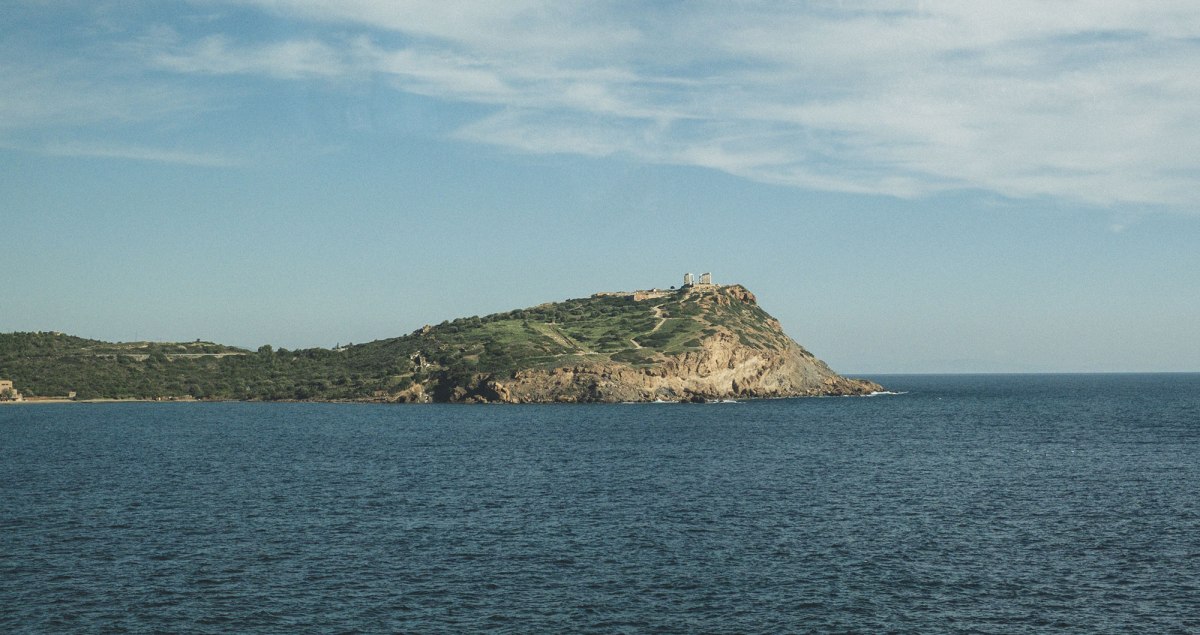
After our museum adventures, we attempted to visit the architectural site of Cape Sounion (Aκρωτήριο Σούνιο), home to the Temple of Poseidon, a major monument of the time of Pericles.

Our timing was, however, unfortunate, as Athenians were striking at the time due to the Tempi Train Crash, so that we found the site closed and were unable to come much closer than this.

While sad not to be able to see the ruins up close, we still had a stunning view over the Aegean, which takes its name from the mythological king Aegeus, father of Theseus. As he waited for his son to return from Crete after seeking to kill the Minotaur and end the sacrifice of Athenian youths to it every four years, he was fooled by a blunder — Theseus had promised to change his sails to white if he was victorious, and for his crew to leave them black if he had perished. As they forgot to change them once he had accomplished his goal, what Aegeus saw on the horizon told him his son had failed and was dead. Devastated by this, Aegeus threw himself into the sea which now bears his name.


 Gold Colored Fox