
Plaster Casts and Pink Coffee

Μουσείο Ακρόπολης / Acropolis Museum
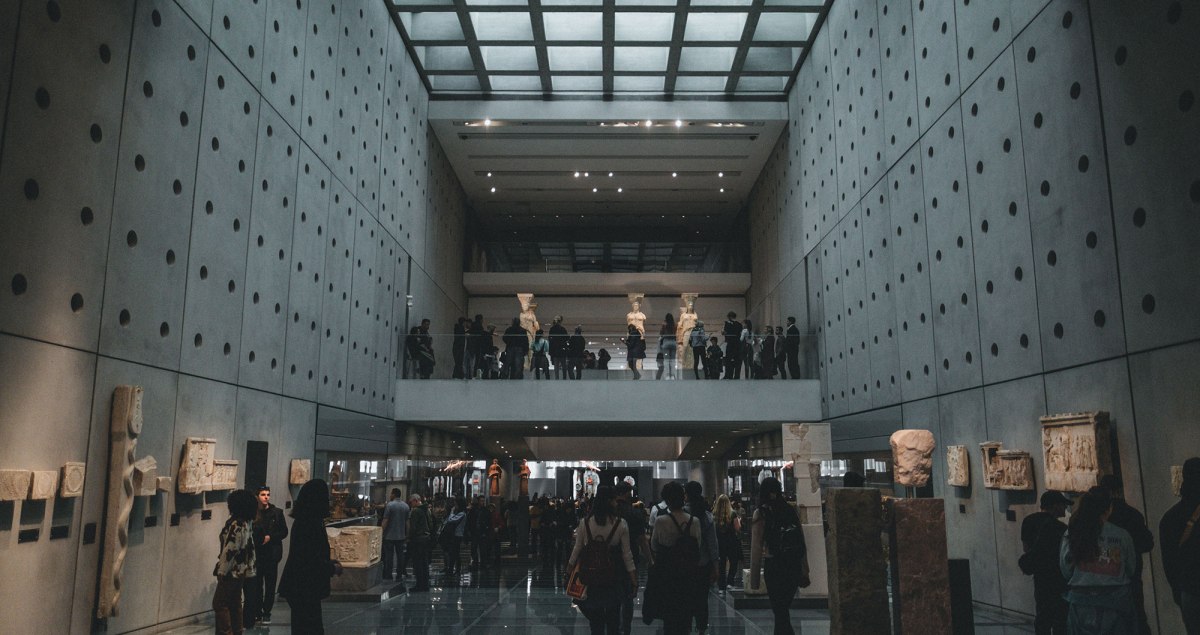
The Acropolis Museum was built to house all artefacts found on the rocky hill as well as the surrounding slopes, with objects ranging from the Bronze Age, the Roman period, and later, the Byzantine. The museum opened in 2009, housing over 4,000 objects and covering an area of 14,000 square meters.


Local investigation and cataloguing of all artefacts located on the Acropolis began after the Greek War of Independence, and so it became imperative to house all of it somewhere, due to the sheer abundance of objects. Thus was a new museum founded in 1865, directly on the Acropolis. It quickly became apparent that it was not large enough to house everything, however, so that a second small building was constructed in 1888. Further structures were added after WWII, and this remained the home of the Acropolis collection until 2007.


In 1979, the Karyatids were removed from the Erechtheion and transferred to the museum, reigniting discussions of a new building with more available space. Architectural competitions were held for years, but no suitable designs ever came from them. A fourth competition was held in 2000, and the winning design (by the Swiss Bernard Tschumi and the Greek Michael Photiadis) was completed in 2004. The Museum opened on June 20th, 2009 – 14 years ago today.


Anatomical votives were given by those who were ill, representing the body part that ailed them. These were found in the Sanctuary of Asklepios on the slopes of the Acropolis.

This steele was found in 1904, south of the Theater of Dionysus. It was dedicated, as per its inscription, by a man named Silon, who might be the man depicted on the marble sandal sole at the top.

This owl decoration was part of a seat, and possibly comes from the Odeion of Perikles, which is no longer extant. As a symbol of Athena, the owl is meant to represent both the goddess and the city of Athens, which is why it would have been used to decorate a public building.


Found east of the Propylaia in 1888, this is believed to be a decorative element. The figure at the center is meant to be Medusa, depicted with tusks, like a wild boar, and was likely meant to serve as an apotropaic (protective) symbol.

These sculpture fragments are attributed to the west pediment of the Hekatompedon, which is believed by some to have been a previous name for the Parthenon. This particular fragment depicts Herakles (Hercules) fighting with Triton (deity of the sea, son of Poseidon and Amphitrite).


From the same pediment, this depicts a three-bodied daemon. The figures clasp in their hands symbols of the elements of water, fire, and air. Their snake bodies would symbolize the fourth: earth.


Since so many of the sculptures from the Parthenon and other Acropolis buildings are missing, these collections are fully recreated using plaster casts. This particular cast depicts Dione and her daughter Aphrodite, though it may also be Gaia (Earth) and Thalassa (the Sea). The original sculptures are in the British Museum after they were forcibly detached from the Parthenon East pediment.


Glass walls allow views of the Acropolis from the Parthenon galleries, among others, always linking back to the origins of the objects found inside the building.


The Karyatids come from the Erechtheion, where they were used in lieu of columns. Originally, they were known as Korai, the plural of Kore (or Maiden), and Karyatid is a word left to us by Vitruvius. It comes from the name for the women of Karyes in Laconia in the Peloponnese, who were punished by the rest of Greece for living in a city that supported Persia and had to carry the weight of all their possessions on their heads. Lucian, however, tells us that the Karyes danced to the grace of Artemis while carrying baskets on their heads.


Korai A, B, D, E, and F are all in Greece, while Kore C (the empty space) is in the British Museum in London. Kore F was destroyed by cannon fire, and the statue fragments have been displayed alongside its sisters since 2009.


These reliefs are taken from the parapet and balustrade, respectively, of the Temple of Athena Nike.

This artefact was found in the Theater of Dionysus in 1866. It depicts Helios, god of the sun, as “Kosmokrator,” or all powerful Ruler of the Universe. Dogs at his feet are meant to represent Sirius and Prokyon, and the rest of the sphere is covered in symbols, allegorical scenes, and esoteric inscriptions.


Located atop Roman and Byzantine structures, the Acropolis Museum building had to be adapted to its site, so as to preserve these ancient ruins. In order to do this, extensive excavations were carried out to determine where to place the pillars that hold the whole building up while allowing the ancient ruins a space to exist. Excavation at this site is still ongoing today.


Ellyz
After the museum, we stopped at the pinkest place I’ve ever been to for a bit of cake and coffee. Pink cake and pink coffee, that is. I didn’t even know such a thing as a pink cappuccino was possible, but I was utterly delighted.


 Gold Colored Fox