
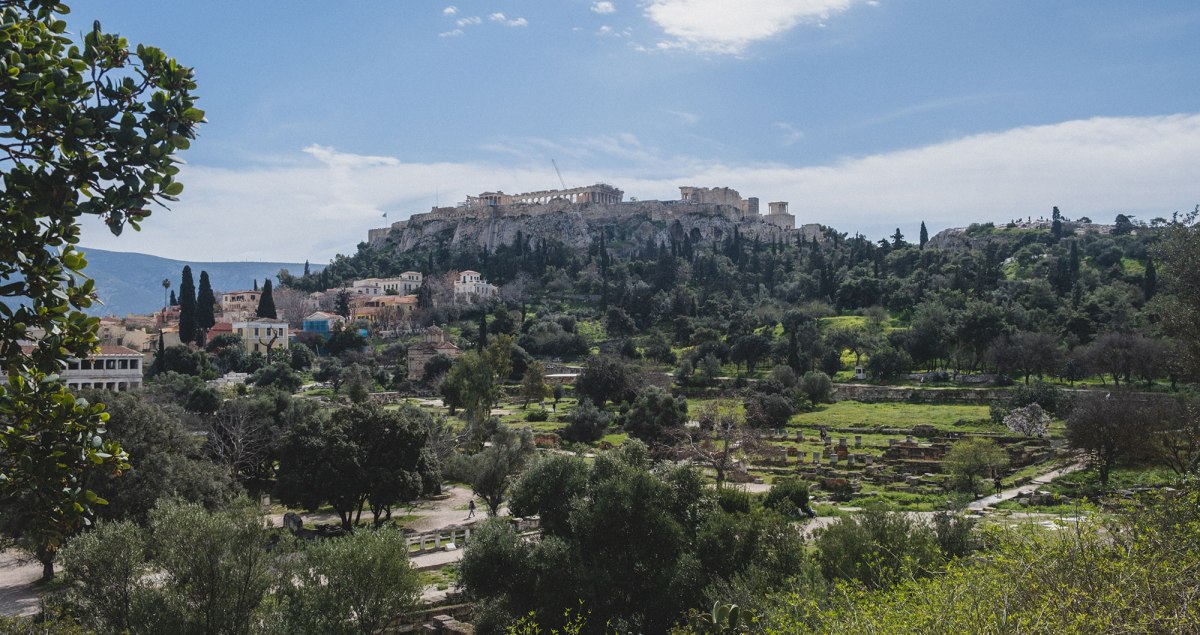
Athens
Known locally as Αθήνα (pronounced “Ah-thee-nah”), Athens is both the capital and largest city of Greece. It is also the eighth largest urban area in Europe, as well as one of the world’s earliest cities, with a history spanning over 3,400 years (though human activity has been recorded as early as the 11th millennium BCE).

The history of Classical Athens is well documented, and we’re all somewhat familiar with the names of its ancient philosophers, such as Socrates, Plato, and Aristoteles. Popularly, the city is known as the “cradle of Western Civilization” and the “birthplace of democracy,” and it was particularly influential on Ancient Rome, which was itself influential upon every land it conquered. Evidence of its ancient past is clearly visible in the Athens of today, which is dotted throughout with ruins, ancient monuments, and works of art. Often conquered by outside forces, the city also shows a strong influence of Roman, Byzantine, and Ottoman culture.

The name of the city is strongly linked to that of its patron goddess — Athena. According to the city’s founding myth, both Athena (goddess of wisdom and war) and Poseidon (god of the sea and earthquakes) competed for patronage of Athens. As such, each provided the city with a gift: Poseidon struck the earth with his trident and a salt water spring burst forth; Athena offered the Athenians the first domesticated olive tree. The goddess’s gift was accepted, and thus she became forever its patron and protector.

After the peak of its Golden Age, Athens was conquered by Macedonia, and later by the Romans. Emperor Hadrian (builder of the Castel Sant’Angelo, the Templum Veneris et Romae, and the Ponte Sant’Angelo in Rome), who had been granted Athenian citizenship and admired the city greatly, invested significantly the construction of new monuments. These included a library, a gymnasium, an aqueduct, and the completion of the Temple of Olympian Zeus.

The city fell into decline with the rise of Christianity, and it was eventually conquered by the Ottomans in 1458 (nearby Constantinople had fallen to them in 1453). The Greek territory fought for its independence for centuries, eventually achieving it in the 19th, and Athens was chosen as the capital of the new Independent Greek State in 1834. It was subsequently renovated by the first King of Greece, Otto of Bavaria, who commissioned the architects Stamatios Kleanthis and Eduard Schaubert to design a modern city plan. This included wide avenues, gardens, and public buildings, as well as the first street names to be used in Athens.

Modern Athens boasts great ruins, loud streets, and delicious food. Much like Rome, I recommend understanding that your relationship with moving cars is unlike whatever you might know at home. Also, did I mention that the food is delicious?
 Gold Colored Fox