
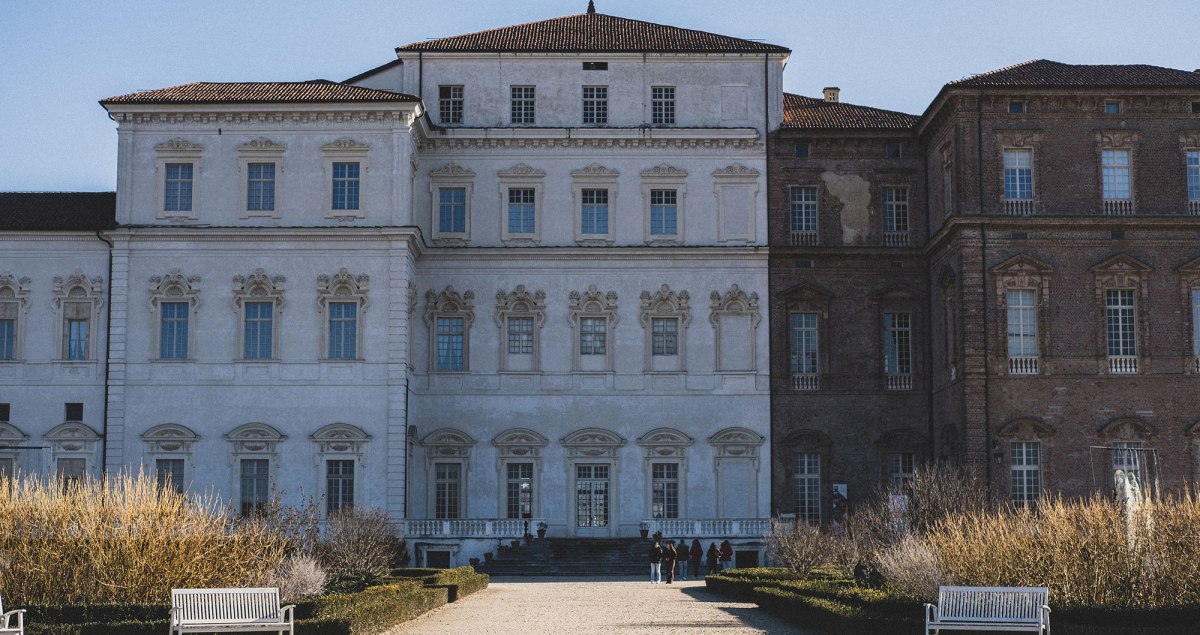
Reggia di Venaria Reale

Reggia di Venaria Reale
The Palace of Venaria, located in Venaria Reale, was originally designed by Amedeo di Castellamonte, much like the rest of the tiny town, in order to provide Duke Charles Emmanuel II with a hunting lodge in the region. The structure was eventually expanded to become a luxurious residence worthy of the House of Savoy, and it was designated a UNESCO World Heritage Site in 1997.


During my visit, the palace hosted an exhibition titled Turner. Landscapes of Mythology, exploring J.M.W. Turner’s landscape paintings.


Most of the works on show (about 40 in total) were drawn from his collection held by the Tate Britain, and included oil paintings, oil sketches, and watercolors.


Turner was greatly influenced by the landscapes in Italy, which he had seen and traveled through extensively, and often used them as backdrops for his mythological subjects.


Some of the palace complex buildings were destroyed in the late 17th century, and so Victor Amadeus II decided to inspire its reconstruction on none other than the Palais de Versailles, with Michelangelo Garove as the architect in charge of this project.


Further damage was done to the building in 1706 during the Siege of Turin, and after this Victor Amadeus II entrusted Filippo Juvarra (architect of the Palazzo Reale, Chiesa di San Filippo Neri, the façade of the Parrocchia della Santissima Annunziata, and the entrance hall at the Villa della Regina) with the project to enlarge and reconstruct the palace.


Further additions were completed later in the century, with decorative elements in the time of Victor Emmanuel I adding the finishing touches. The palace fell out of use as a palace in the 18th century, and was used instead as military barracks.


The centerpiece of the 18th century wing of the palace (and arguably of the entire structure) is the Galleria Grande, or Grand Gallery. It was a Pinterest picture of this that first alerted me as to the existence of this palace in the first place, and let me tell you something, in pictures this space looks wondrous, but they do not do the scale of it justice.


The space is decorated with carvings completed by Pietro Filippo Somasso, Giuseppe Bolina, Antonio Papa, and Giovambattista Sanbartolomeo, and features 44 arched windows and 22 eyelets.


It originally held a large collection of stuccos, statues, and paintings by artists of the time. Its floor was moved to the Beaumont Gallery in Turin during the French occupation, and the one currently in place is a copy emulating Juvarra’s original design.


Also, I got supremely lucky and reached it as people were filing out, and had a bit of a respite before a tour group that was at my heels invaded the gallery. The room was still beautiful, of course, but the serenity of it? Utterly shattered.


Juvarra was commissioned by Victor Amadeus II to build a church dedicated to Saint Hubert, patron of hunters. It was built between 1716-1729 and features a (gasp!) fake dome, as its position within the palace complex did not allow for the construction of a proper dome. Instead, tromp-l’œil was employed by Giovanni Antonio Galliari, and it is so effective that I didn’t even realize it until I researched this post.


The church’s High Altar was completed by Giovanni Baratta, and was designed to be bathed in the light that enters through the windows directly behind it.


The Royal Stables is an exhibition housed in the Great Stables of the palace, and which hosts the Bucentaur of House Savoy as well as ceremonial horse-drawn carriages used by the royal family in the early 19th century.

The Bucintoro (in English, Bucentaur) was the Venetian Doge’s ceremony ship. It was destroyed in 1798 at Napoleon’s orders, but Victor Amadeus II had commissioned a copy, so that today it is the only existing one of its kind.


This space, which today holds historic horse-drawn carriages, once held the Great Stables, which itself housed around 200 horses belonging to the House of Savoy. It served this same purpose during the 19th century, when the property was used as military barracks.


The current gardens at the Reggia di Venaria Reale unfortunately do not reproduce any of the historical designs for the palace complex, as those were destroyed when the property was used for military purposes. The current layout, instead, is inspired by the old designs, but still infused with modern sensibilities and practical considerations.


Over the years, some renovation work was completed, but it wasn’t until 1996 that a huge project was approved (undertaken between 1999 and 2007) to renovate the entire complex and restore it to its former splendor. The project is considered to be the largest of its kind in European history, involving 700 experts, 300 companies and contractors, and 1,800 workers. The Reggia di Venaria Reale opened to the public in 2007.


 Gold Colored Fox