
A City of Baroque Austerity

I arrived on the last day of November to what I remember thinking was a devilishly cold Turin. It was rainy, cloudy, and windy, and while I famously adore raining as long as I get to stay indoors, something in me got very excited because on the bus from the airport to the city center I caught the intense red and rusty brown of drying leaves on every single tree, a much deeper autumn than I’d gotten in Madrid.

Thankfully, Turin is one of those places for which rain is undeniably suited — I found it a city of dignified beauty and quiet elegance, and it felt infinitely obvious that it had a past as the capital of first a duchy and then a kingdom.


Piazza San Carlo
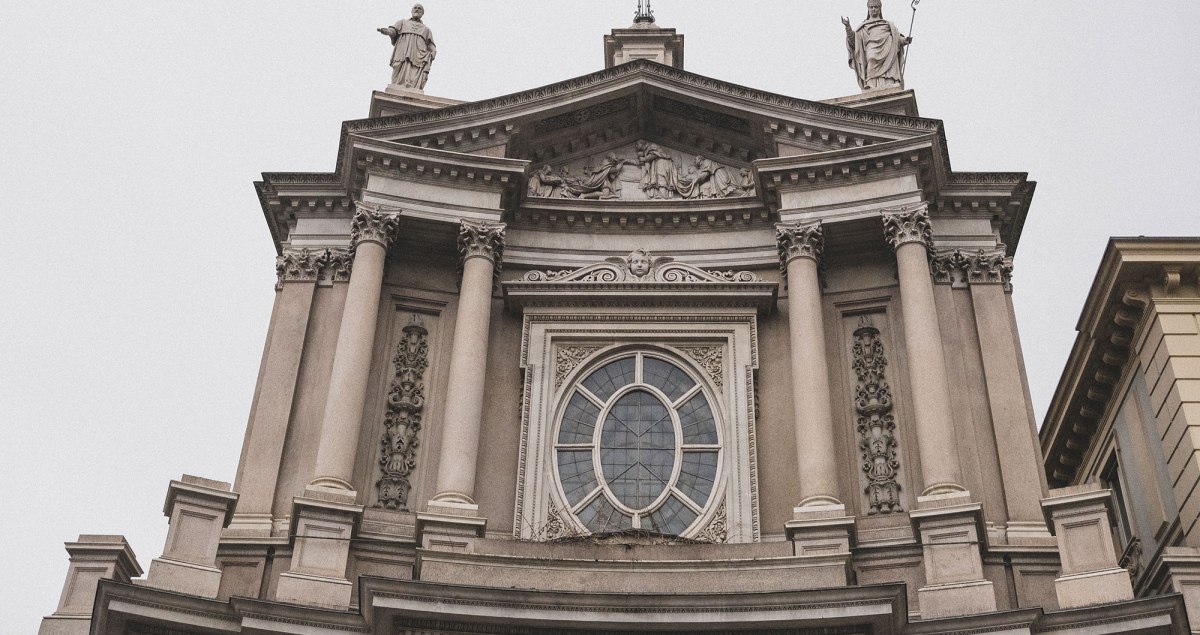
Previously known as Piazza Reale (Royal Square), Piazza d’Armi (Barrack Square), and Piazza Napoleone (Napoleon Square), the Piazza San Carlo is a Baroque-style square built in the 16th and 17th centuries. It is framed by arcades designed by Carlo di Castellamonte in 1638 and crowned by the twin churches of Santa Cristina (on the picture above covered by scaffolding and a dignified Lavazza ad) and San Carlo Borromeo.


Turin is dotted with Martini and general vermouth signs, as the brand itself is from Turin and vermouth is widely believed to have originated (in its current form) in the region of Piedmont. Other famous exports from the city of Turin include gianduiotti which are ingots made out of chocolate and hazelnut (a mixture similar to, and the origin of, Nutella) and bicerin, a drink made out of espresso, chocolate, and milk, topped with whipped cream.


This equestrian monument, also known in Piedmontese as Caval ëd bronz, was created by Carlo Marochetti in 1838 in his workshop in Paris. It was commissioned by King Charles Albert of Savoy to commemorate the military feats of his ancestor, Emmanuel Philibert, Duke of Savoy.


Caffè San Carlo
I stopped for a quick coffee-and-cream-croissant break at Caffè San Carlo, which has to be one of the most beautiful cafés I’ve ever been in. It is located in the Palazzo Turinetti di Priero, on the Piazza San Carlo, and it is one of the oldest cafés in Turin.


It originally served as a meeting place for those who drove the Risorgimento (the Italian unification movement), as well as for intellectuals and artists.


Via Roma
Acting as the Main Street in the Turin city center, Via Roma was built during the Fascist era, following the principles of the Italian Rationalism architectural movement. The street runs from Piazza Carlo Felice to Piazza Castello, and is bisected by the Piazza San Carlo.

The southern section of the Via Roma was designed by the rationalist architect Marcello Piacentini, and is characterized by its austere buildings. It is a very stark contrast to the Baroque opulence of Piazza San Carlo, though its double-column design is meant to be consistent with the earlier square.


The northern section of the street is done in a more eclectic style, not quite so sparse, and leading up to the Piazza Castello, which is considered to be the very center of Turin, and the location of the Palazzo Madama and Palazzo Reale.


Galleria San Federico
Built in the 1930s and adjacent to the Via Roma, this gallery serves as a type of shopping center, hosting a number of stores under this stunning architectural design.


The Galleria is also home to the Cinema Lux. It was opened as the Cinematografo Reale in 1913, rebranded as the Cinema Rex in 1934, then Cinema Dux, and then after WWII, Cinema Lux. Closed for years due to renovation work, it opened again in 2009, and still functions as a cinema today.


 Gold Colored Fox