
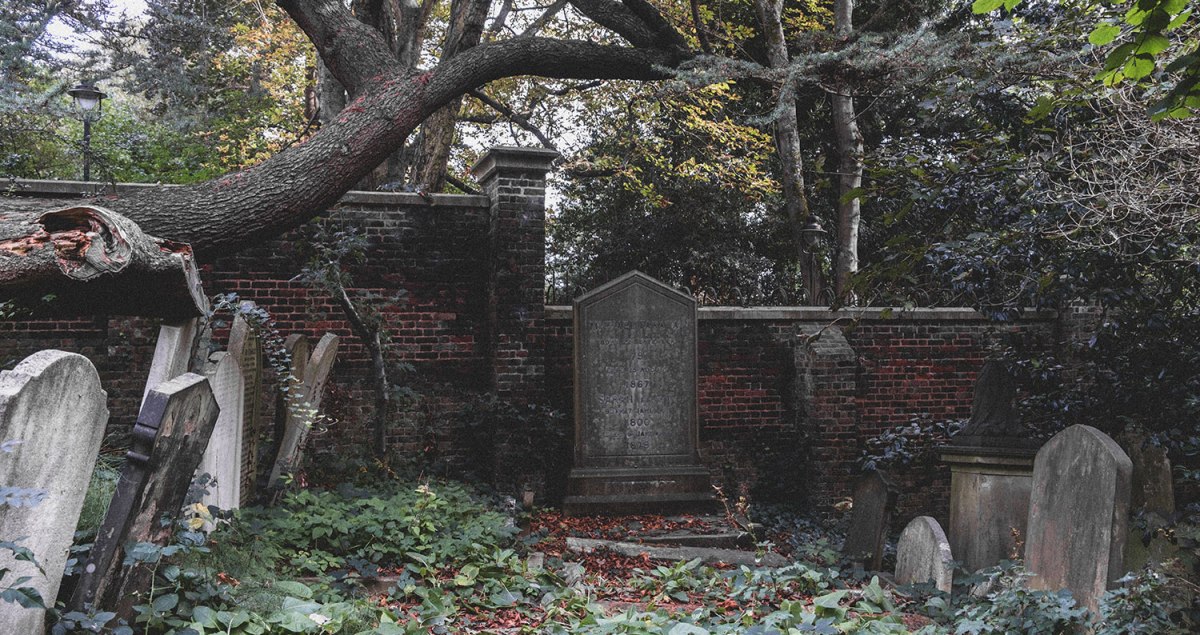
Peace. Perfect Peace.

Highgate is a suburban neighborhood located in the north of London, and often considered one of the most expensive in which to live. It was originally a distinct village outside of the city, and historically the Bishop of London’s hunting estate, a function from which its name comes (because of the high ledge that surrounded it). The area has a number of landmarks, many of them churches, but perhaps its most famous spot is the Highgate Cemetery, which was the reason I visited.


Highgate Cemetery
Highgate Cemetery is one of a group of cemeteries which has since become known as the “Magnificent Seven.” It refers to a project that sought to build seven new cemeteries in the outskirts of London in order to ameliorate the overcrowding in parish burial grounds as the city population grew.


While proposals for such a plan had existed for years, it wasn’t until George Frederick Carden (barrister, magazine editor, and businessman) visited the Père-Lachaise Cemetery in Paris that he was inspired to truly pioneer the movement to move burials elsewhere.

The first was Kensal Green (1833), located in north-west London, but Highgate Cemetery followed soon after and was officially established in 1839 with a design by Stephen Geary. 15 acres were consecrated, with an additional 2 set aside for dissenters, and in 1854 an additional 19 acres were acquired across the street in order to create the cemetery’s eastern extension, which opened in 1860.


Today, Highgate holds 170,000 people in 53,000 graves across both East and West Sides. It has also been the site of numerous books (Her Fearful Symmetry by Audrey Niffenegger, for example) and movies (Taste the Blood of Dracula and Tales from the Crypt).

West Side
The West Side of the Highgate Cemetery is characterized by much more elaborate tombs and winding paths that are much more densely overgrown. It was, unsurprisingly, my favorite side, and while I initially visited with a tour (it is the only way to access the Terrace Catacombs), I later had the chance to wander its pathways on my own (or, as the case may be, in very good company 👻).


The first burial was Elizabeth Jackson, of Soho, but many famous personages followed, including several members of the Dickens family (Charles himself is buried in Westminster Abbey), Michael Faraday, Lucian Freud, Stephen Geary, Henry Gray (author of Gray’s Anatomy), Radclyffe Hall, Alexander Litvinenko, and George Michael.


The Egyptian Avenue (and the Lebanon Circle it leads to) are both Grade I listed buildings, which means they are maintained and protected by Historic England, an executive body of the English government.


The design for this area of the cemetery was created in a time period when society was obsessed with Ancient Egypt, and it was greatly inspired by the descriptions of Thebes provided by Giovanni Belzoni (responsible for acquiring objects for both the British Museum and John Soane’s collection).


This was very attractive to both visitors (who often strolled through the cemetery and held picnics on its grounds) and prospective lot owners, whose prestige would increase by being buried in such a fashionable place.


The Circle of Lebanon was once crowned by a Cedar of Lebanon, a massive tree that had reached the ripe old age of 280. It was unfortunately cut down in 2019, as it was in danger of collapse, which would have damaged the circle of vaults below. It was replaced by a new specimen, but it will be some time before this area regains its old glory.


Radclyffe Hall was an English poet and novelist, author of The Well of Loneliness, which is considered by many to be the most important lesbian novel ever written. Hall had a long-term relationship with Mabel Batten, a singer of Lieder, until the singer’s death in 1916. Batten is buried in a vault in the Lebanon Circle, which Hall chose to share with her when the time came.


The Terrace Catacombs are available to visitors only as part of the guided tour through the cemetery. Even when it first opened, it was considered one of its main draws, and often used in its advertisements. As this was the only area of the cemetery perpetually locked, it was considered to be the safest. The terraces above it were meant to provide a view of London, though today the surrounding vegetation obscures much of it.


The Mausoleum of Julius Beer was created to honor his daughter, Ada, who passed away at the age of eight during an epidemic of scarlet fever in 1875. I didn’t have a chance to see the interior, but you can do a little 360-tour here.


The empty space at the center of this photo, though unmarked, is where many young women (some of them technically children) were buried after living what life they could in the streets of Victorian London. They had been sent to the Highgate Penitentiary, a correctional facility for prostitutes, died under unknown circumstances, and were then laid to rest here anonymously until two volunteer guides (Rowan Lesson and Sam Perrin) discovered their identities.


East Side
Though the East Side of Highgate is not much newer than the West (it was established a mere 21 years later), there’s something about it that feels a bit fresher, lighter, and more open than the almost haunted forest-like quality of the West Side. The East Side holds the graves of Douglas Adams, Karl Marx, and Mary Ann Evans (best known as George Eliot), among others.


There were reports of paranormal activity at the Highgate Cemetery during the 1970s and 60s. It seems young people went to the cemetery with the intent to experience the occult, and they vandalized graves by taking flowers and placing them in circular patterns, opening coffins, and even going as far as to drive an iron stake through one of the lids and into the corpse inside. This was quickly linked to existing reports of the “Highgate Vampire,” who had been allegedly glimpsed inside the cemetery by several people.


Sean Manchester (an author and self-proclaimed exorcist) and David Farrant (a “Psychic Investigator”), who quickly became rivals, each claimed that they would go to the cemetery and expel the specter/vampire. This resulted in a mob of “hunters” from all over London overpowering police and swarming the cemetery.


There were more incidents, including the body of a woman being found in the cemetery, as well as both Farrant and Manchester paying it subsequent visits to purify the place or drive stakes through coffined bodies. Their feud continued up until 2019, when Farrant passed away.


 Gold Colored Fox