
The Haunting of Strawberry Hill House


Strawberry Hill House
Located in Twickenham, a suburban district of London, Strawberry Hill House was a project Horace Walpole — English writer, art historian, antiquarian, and politician — worked on beginning in 1749. Walpole was also the author of The Castle of Otranto (1764), which is considered to be the first Gothic novel.


The history of the property under Walpole’s influence begins in 1747, when he took a lease on the existing house after being pressured into establishing a country seat and a family castle, which was then a fashionable practice. He purchased the home a year later and summarily changed its name to Strawberry Hill Shot (it was originally called “Chopped Straw Hall”), once he found an old lease that described it thus.

He slowly rebuilt the home to fit his own tastes, expanding it from its original 20,000 m2 (5 acres) to its current 190,000 (46) with the help of the Strawberry Committee (also known as the “Committee of Taste”), comprised of John Chute (connoisseur and amateur architect) and Richard Bentley (draughtsman and designer), although the latter left the group after an argument in 1761.


When actually working on the construction, Walpole enlisted the assistance of William Robinson, from the Royal Office of Works, and looked to other buildings for inspiration. He even drew inspiration from Westminster Abbey, creating fireplaces inspired from engravings of tombs, and adding details to the walls using painted wallpaper that resembled Gothic stone details. The Round Tower, added in 1771, includes a chimney-piece based on the tomb of Edward the Confessor.


The end result is that the home is a mish-mash of features inspired by both castles with turrets and battlements, and Gothic cathedrals with arched windows and stained glass, giving the structure a strikingly irregular silhouette and plan. This is emphasized by the fact that Walpole added extensions to the building in subsequent years as he saw fit, without following a set plan from the beginning.

A wonderful thing about Strawberry Hill House is that there is a docent in every room waiting to share its secrets with visitors as soon as they walk in. The story involving this particular fishbowl is not very pleasant, as it seems to have caused the accidental death by drowning of Walpole’s cat, Selima, while he lived in London. This event was then immortalized in a mock-heroic poem by Walpole’s friend, Thomas Gray, titled Ode on the Death of a Favourite Cat, Drowned in a Tub of Gold Fishes in 1747.

The interior of the Strawberry Hill House, which Walpole later said inspired his book, The Castle of Otranto, was meant to create an atmosphere of “gloomth” for Walpole’s collection, which he eagerly publicized, encouraging people to visit and admire it — though always to the exclusion of children. These visitors included people, first, from the surrounding neighborhood, then expanded to the town, and eventually even included members of the royal family.


The house was left to relations after Walpole’s death, and in 1842 most of its collection was sold off to pay off debts by John and George Waldegrave, who spent most of the family fortune. This collection, most of which is currently held at Yale University, included some truly spooky objects: a clock given to Anne Boleyn by Henry VIII; a red cardinal’s hat believed to have been owned by Cardinal Wolsey (adviser to Henry VIII); and a portrait of Sarah Malcolm, triple murderer, by William Hogarth.


The library was, without a doubt, my favorite room (and my main reason for visiting, if I’m being perfectly frank). It is what bookish dreams are made of, an absolute wonder of a room that I had to drag myself out of, as there was still more house to see. I would come back to Strawberry Hill House a thousand times, and they would all be just to see this room again.


The door on the left, I was told, was where Walpole kept those books he wanted out of reach from the strangers who would visit his collections. He would simply close the door, turn the key, and go for a walk, knowing his precious possessions were safe from prying eyes and wandering fingers.


While the collection currently housed by these shelves does not include Walpole’s original possessions, they do provide a glimpse into the sort of tome he would have owned and kept in a room such as this.


Walpole used the Holbein Chamber to keep copies of drawings by Hans Holbein, a Renaissance German-Swiss painter who was prolific in his creation of Tudor portraiture, which Walpole was obsessed with.


This carved wooden screen was designed by Richard Bentley based on the choir doors of the church of St. Ouen, in Rouen, France.

The fireplace, also by Bentley, was inspired by the tomb of Archbishop Warham in Canterbury Cathedral, and its ceiling, by the Queen’s Dressing Room at Windsor Castle, which was unfortunately destroyed in a fire in 1992.


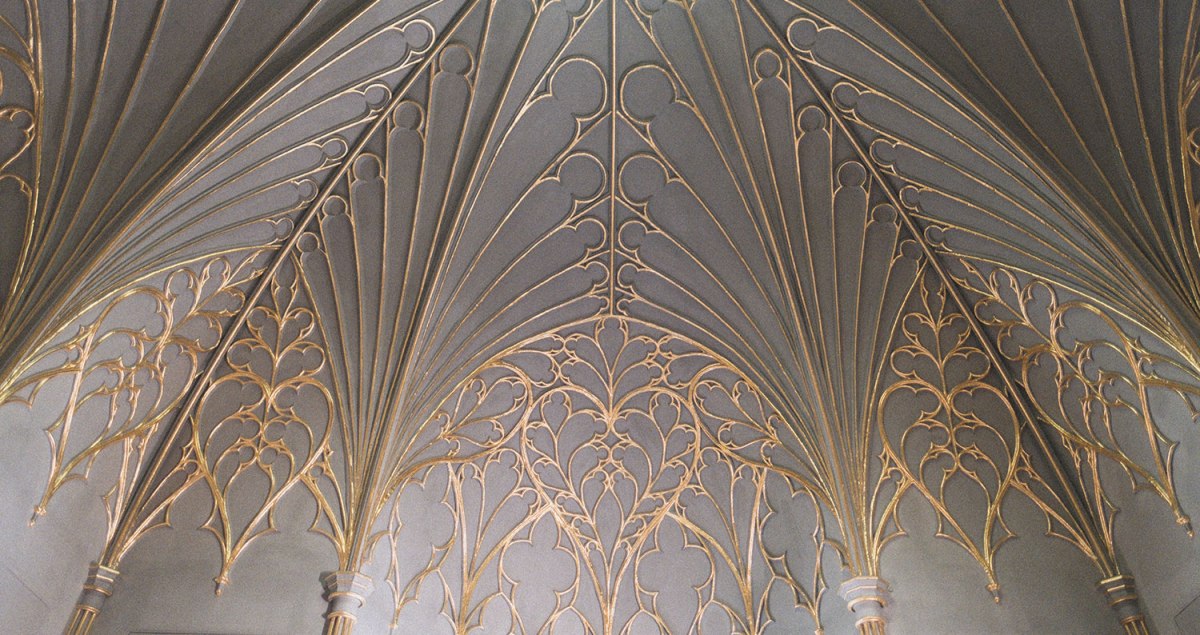
While the Library was my favorite room, the Gallery was probably the most impressive. The design for the fan-vaulted ceiling in particular was taken from Henry VII’s Chapel at Westminster Abbey.


Walpole colorfully described this room as being “all Gothicism and gold and crimson and looking glass,” and used it to display his art collection and entertain visitors. Honestly, I suppose if I had a room like this to show off I would also be willing to have people over to look at my stuff.


The Round Room is located, surprisingly, in the Round Tower, which was added to the home in 1771.


Here at the center you can see an English copy of the marble sculpture created by Filippo della Valle in bronze to depict Horace Walpole’s mother (Catherine Shorter, Lady Walpole). The original stands today in Westminster Abbey.

This room is known as the Tribune, which was an exclusive room in the Strawberry Hill House, and which only a select few were ever allowed to visit. It was created in imitation of the Tribuna at the Uffizi in Florence, meant to hold the collection’s most precious objects.

 Gold Colored Fox