
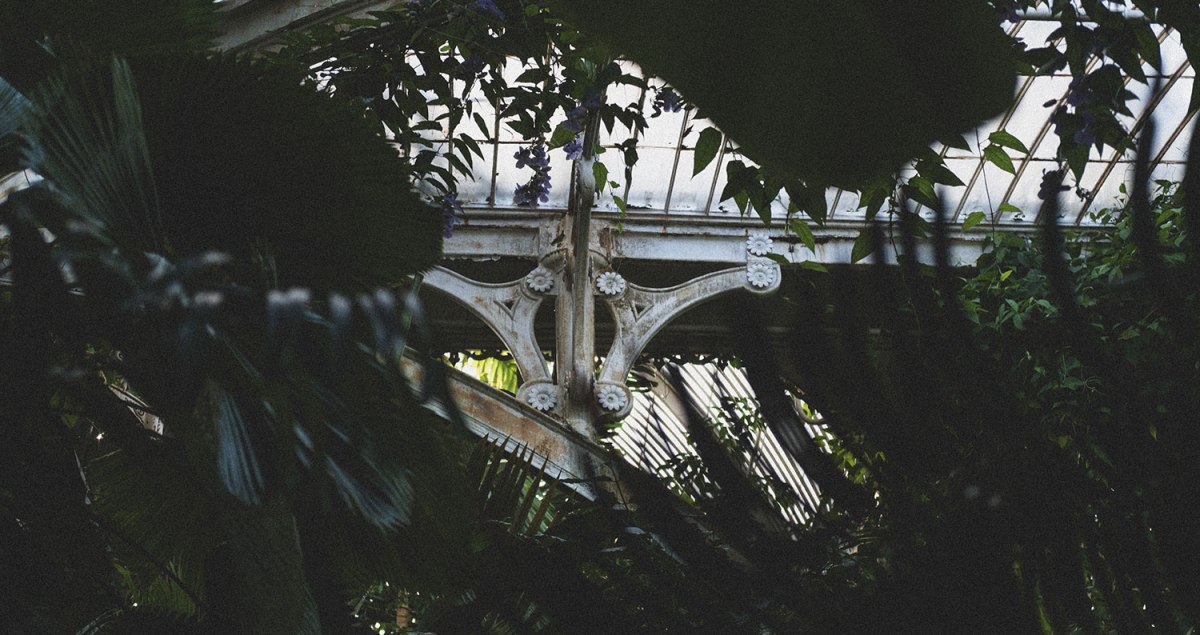
Of Glass and Steel and Green

Kew is a district of London which is mostly made up of Kew Gardens and a small residential area. It is believed that Julius Caesar may have forded the Thames at Kew during the Gallic Wars in 54 BCE, and monarchs of the various Tudor, Stuart, and Georgian dynasties kept close ties with Kew throughout their reigns. The area also served as refuge during the French Revolution, and as the home of a number of artists during the 18th and 19th centuries, including Thomas Gainsborough and Camille Pissarro.


Kew Gardens
I love a botanic garden. Through the years, I had Kew saved in my head as the Mother of All Botanic Gardens, and it was one of the places I was most excited to visit when I was in London. The place did not, in a word, disappoint. Also, it is massive, so I prioritized visiting the greenhouses, but will definitely need to return in order to see all I missed.


The botanic garden started as the “exotic garden” of Kew Park, formed by Henry Capell, 1st Baron Capell of Tewkesbury, and later enlarged in the 18th century by Augusta, Dowager Princess of Wales. Its collections grew in a more organic manner (hah!) until the garden appointed its first collector in 1771 — Francis Masson, a Scottish botanist and gardener who Wikipedia describes as the Kew Gardens’ “first plant hunter” (my imagination is running wild).

The gardens were adopted as a national botanic garden in 1840, mostly due to the work of the Royal Horticultural Society and its president, William Cavendish, and were declared a UNESCO World Heritage Site in 2003.

This line of statues is known as “The Queen’s Beasts.” The originals were designed by James Woodford (these are replicas made by the same sculptor), and placed in front of the Westminster Abbey for Queen Elizabeth II’s coronation in 1953, each representing a heraldic badge of the various strands of her royal ancestry.


Palm House
The Palm House at Kew Gardens was designed jointly by Decimus Burton and Richard Turner, and was built between 1844-1848.


It became a status symbol during Victorian times to have a Palm House in botanical gardens, mostly characterized by being highly ornate glass and iron structures. One of the earliest examples can be found in the Belfast Botanic Gardens, a project in which Richard Turner also participated.


The stairs leading up to the upper level of this greenhouse had a sign: “Very high humidity and very high temperature (>35 ºC). Please be aware and make sure you are fit for these conditions.” The Floridian in me laughed and climbed upwards.


Waterlily House
This is the hottest and most humid of the houses at Kew, but it’s so beautiful and whimsical that it’s absolutely worth the nightmarish sensation of evaporating to join your surroundings just to go inside.


The interior is so overgrown, so absolutely conquered and owned by vines and flowers, that it feels like something out of a fairy tale.


It was built to house Victoria Amazonica, the largest of the water lily family Nymphaeaceae. The house did not suit the specimen, however, and it ended up moved elsewhere. Richard Turner once again provided the ironwork for the house, which was completed in 1852.


Princess of Wales Conservatory
Opened in 1987 by Diana, Princess of Wales to commemorate Princess Augusta’s associations with Kew, the Princess of Wales Conservatory was designed by Gordon Wilson, replacing 26 smaller buildings.


Currently, it houses ten micro-climatic zones, mostly Dry Tropics and Wet Tropics plants, all controlled electronically. It includes water lilies, orchids, cacti, and carnivorous plants (with signs warning visitors not to feed them!).


Temperate House
Also designed by Decimus Burton and Richard Turner, the Temperate House at Kew took nearly 40 years to build — it was started in 1860 and completed in 1899.


It is the largest surviving Victorian structure in the world, and twice the size of the nearby Palm House, covering an area of 4880 square meters (52,528 square feet).


The structure contains plants and trees, 1,200 species in total, from Asia, Australasia, the Americas, and Africa. Kept at a steady 10 ºC, it was the most comfortable (and driest) of all the greenhouses.


I was so happy to encounter this little guy again. It’s a leucadendron argenteum, and the first time I saw it was at the Glasgow Botanic Garden.


It is commonly known as Silver Tree, or Silver Leaf Tree, since its leaves look like they’re made out of silver. It is an endangered species indigenous to South Africa, and remarkably short-lived, not usually surpassing 20 years.


 Gold Colored Fox