
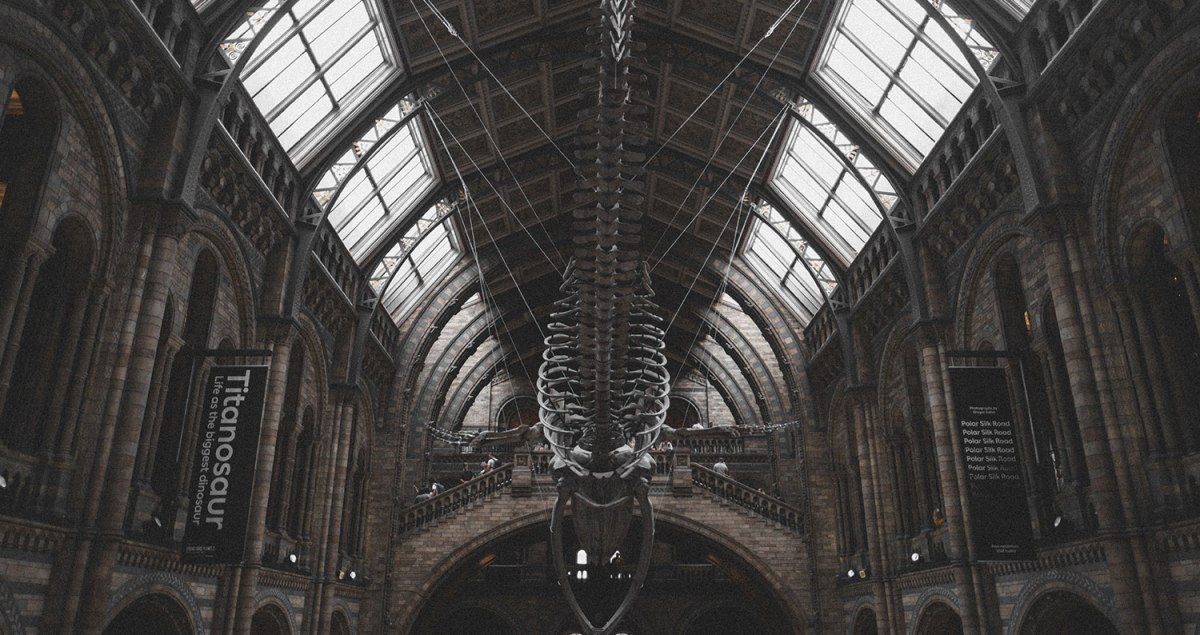
Of Skeletons and Dark Halls


This skinny little house was an artist’s studio in the 19th century, though today it’s been refurbished to serve as multiple flats. It was designed by George Basevi, a student of Sir John Soane (whom we’ll meet later). While the building looks impossibly thin, the fact that it’s actually triangular (which you can easily appreciate in this picture) makes it so that it’s much larger on the inside than it looks on the outside at first glance.


Natural History Museum
The basis for the collection now at the Natural History Museum in London was amassed by Sir Hans Sloane (who is also responsible in large part for the collections of the British Museum and British Library). Fun fact: he is apparently credited with inventing chocolate milk, though it’s likely he simply learned the practice after spending time in Jamaica. Talk about a telling anecdote.


Upon his death in 1753, the collection was housed in Montagu House, Bloomsbury, a late 17th-century mansion which was at the time the home of the British Museum (of which the Natural History Museum was initially part).


Apparently much of the collection donated by Sloane disappeared by the early 19th century, due to the cremation of any decayed specimens (and the Keeper of Natural History selling many objects to the Royal College of Surgeons). Due to this and other practices (such as appointing family members of the Trustees to positions within the institution instead of by qualification), the institution was not considered trustworthy, and as a result the Treasury refused to trust the museum with costly specimens obtained at their expense.


Some of the institution’s faults were corrected by Richard Owen, a biologist, comparative anatomist, and biologist who was appointed Superintendent of the Natural History departments at the British Museum in 1856. He also soon decided that the collections required much more space than they had available at the time, and thus launched a campaign to purchase new land in South Kensington and construct a new building.


The Civil Engineer Captain Francis Fowke won a competition to build the new museum sctructure, though he died shortly afterwards, with Alfred Waterhouse taking over the project (after a substantial revision of the design). Construction began in 1873 and was partially completed in 1880, with the museum opening in 1881. It was formally finished in 1883.


Even after the collection was moved, it remained a part of the British Museum, with the institution being known as “British Museum (Natural History).” In 1866, a petition to the Chancellor of the Exchequer was signed by the heads of the Royal, Linnean, and Zoological Societies, as well as a number of naturalists, asking for the museum to gain independence. It was not until 1963, however, that it became its own museum, though it retained its old name. In 1989, it finally rebranded itself as the “Natural History Museum.”


The museum holds an important and extensive collection of books, manuscripts, journals, and pieces of art related to scientific research, and it is today globally recognized as a great center for the study of natural history. It also receives upwards of 5 million visitors each year.


Better known as Hope, this skeleton belonged to a blue whale which was found stranded on a sand bar in Wexford Harbour, in Ireland, in 1891. She unfortunately agonized for two whole days until the fisherman who found her, Edward Wickham, killed her.


Her carcass was sold at auction and salvaged for whale flesh and blubber, and her bones were purchased by the Natural History Museum for £250. The skeleton was kept in storage for decades, until it went on display at the Mammal Hall in 1934.

Analysis of the baleen plates (a filter-feeding system inside the mouth of the whale) provided a bit of history for Hope: she is calculated to have been 15 years old, and to have lived in the tropical Atlantic for about seven years, after which she began a cycle of migrating north to feed on krill in the summer, and then south to flee the cold each winter. She then spent a year in the tropics, perhaps with a calf, and was on her way to migrate north again when she became stranded after being injured by whalers.


The American mastodon at the NHM (which came to be known as the Missouri Leviathan), was uncovered by Albert Koch, an explorer who made a living out of turning the curiosities of the natural world into a spectacle. This particular specimen was found in Missouri, USA in 1840, and after excavating and assembling it, it was about twice the normal size for this animal. This was, in fact, the result of Koch combining the bones of more than one mastodon, going as far as to add wood between the additional vertebrae to create a more impressive creature. Koch’s traveling show was so successful that it came to be displayed in an exhibition hall in Piccadilly, where Richard Owen caught sight of it, and summarily purchased the specimen for the NHM. Owen then re-assembled the skeleton, coming quite close to an accurate placement for each of its bones, even by today’s standards.


The museum holds one of the world’s most important dinosaur collections, which includes 157 different species. It was founded on the collection of Gideon Mantell, an obstetrician, geologist, and paleontologist whose attempts to reconstruct the skeleton of the Iguanodon began the scientific study of dinosaurs. The collection has since grown to include specimens from the UK, North America, Southern and Eastern Africa, and more.


This fearsome guy was an animatronic feat, which roared and growled to its electronic heart’s content. He’s so scary that there was a sign warning you, and providing an alternative route, an escape chute by which to avoid having to lay eyes on the formidable creature altogether. I was brave and paid my respects, but I admit, dear reader, I was tempted.


Have you ever wondered what dinosaur best represents you? Never fear, I got you: look no further than this handy link. I am apparently an Amargasaurus, which decorated its spines “to make a social statement.”


The Minerals Gallery was an absolute wonder. It continues to look as it did when the museum first opened in 1881, and still uses the original oak displays.


The ceiling of the Hintze Hall is made up of 162 panels, 108 of which depict individually identifiable plants. It was (likely) designed by Alfred Waterhouse (architect of the building), presumably from specimens found in the museum, and executed by Charles James Lea.


The subjects chosen were considered significant to the history of the museum or to that of the British Empire. You can find an interactive image and more info about this gorgeous ceiling here.


My favorite area in the museum was easily Hintze Hall, which also happens to be the largest public gallery in the museum. The space is grand and so dark, it feels like you’re in an old castle, exploring its many halls and mysterious corridors. Its crisscrossing staircases and overlapping arches heighten this sense of wonder and magnitude, and all the treasures you can find while delving into the collections only add to the fascination.


 Gold Colored Fox
Espectacular!!
LikeLike
Muchas gracias ❤ ❤
LikeLike