
The Last of the Meteorites (Or, Meteora: Pt. 2)

See also Meteora, Pt. 1.

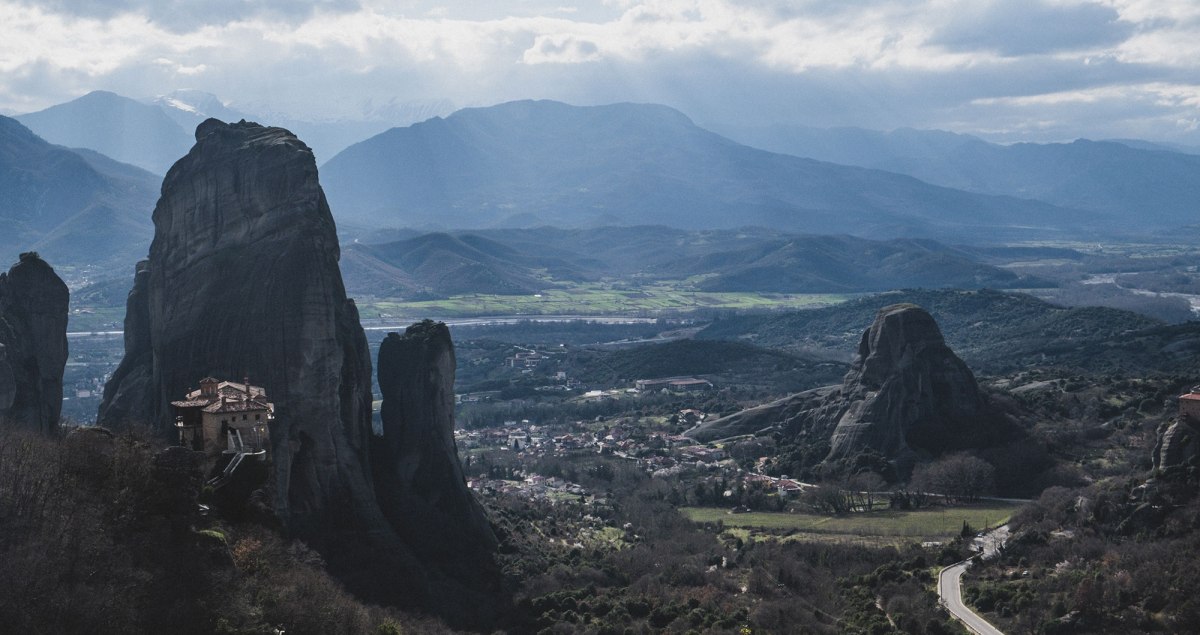
Μονή Αγίου Νικολάου Αναπαυσά / Monastery of Agios Nikolaos Anapafsas
Dedicated to St. Nicholas (Agios means “Saint”), this monastery sits on a rock 80 meters above the valley floor. It is today surrounded by the ruins of other monasteries such as St. John Podromos, the Pantokrator, and the chapel of Panagia Doupiani.


This monastery served as a rest spot for pilgrims, which is where its name comes from – anapafseos means “resting.”


Again, the views.


Δούπιανη / Dupiani
This rock, known as Dupiani, housed the first monastery ever founded in Meteora, the Skete of the Holy Virgin of Dupiani, also called the Panagia Parthenos Kyriakou Monastery. It was founded in 1347 by Hieromonk Nil, as per a chronicle from the 16th century (a hieromonk is a monk who is also a priest). While the monastery itself has not survived, the church into which they all descended every Sunday for the Diving Liturgy has, and some of its frescoes have been preserved. What is visible on this side of the rock is the Monastery of the Pantokrator (Μονή Παντοκράτορος), also called the Monastery of the Ascension of the Lord (Αναλήψεως του Κυρίου). The only way to reach this monastery currently is by rock climbing.


Μονή Αγίας Τριάδος / Monastery of the Holy Trinity
Also known as Agia Triada, Ayias Triádhos, and Aya Triada, all meaning “Holy Trinity.” It sits over 400 meters above the valley floor, and it is one of the oldest monasteries. The Holy Trinity is believed to have been built by a monk called Dometius, who arrived at the site in 1438. Before the 20th century, reaching the monastery involved climbing the rock outcrop to reach the entrance, and provisions were placed in baskets and drawn up by rope ladders. Today, a winch-operated lift can be used.


Μονή Αγίου Στεφάνου / Monastery of Agios Stefanos
This monastery was dedicated to St. Stephen upon construction, and was converted into a nunnery in 1961. Originally built in the 14th century, a new katholikon (the church inside the monastery) was built in 1798, which makes this the newest of all the structures in Meteora.


Hermit Caves of Badovas
Located on Pyxari (Πυξάρι), these cave hermitages hug the side of this rock, formerly inhabited by Christian ascetics. They are located very close to Kastraki (the other town near Meteora). Badovas is the name of a nearby monastery dedicated to Agios Nikolaos of Badovas, which has been restored but is abandoned.


Αμπάρια / Ambaria
This rock hosts cave hermitages that were once inhabited by Orthodox Christian ascetics. The small caves on it were used as sheep stables.


 Gold Colored Fox